|
|
Tools From Clark Co., WI's Past
(Click on photos to enlarge them)
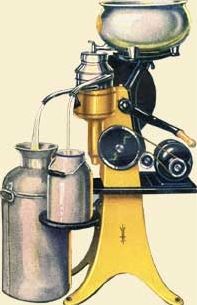
1870 Cream Separator
|
|
Invented in Germany in 1870's, the cream separator would become a fixture on virtually every dairy farm. By the 1920' s thirty American manufacturers. were producing 200,000 hand-cranked cream separators a year. Including tractor manufacturers, stationary engine builders and retail giants like Sears Roebuck. German inventor Dr De Laval' s cream separator that bore his name would become the benchmark all others were measured by. Cheryl Darr
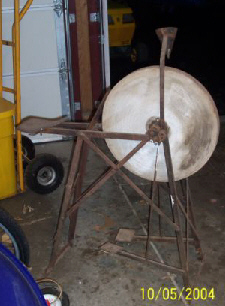
Whetstone (Sharpening Wheel)
|
|
I remember a whetstone in our basement. It wasn't very fancy--wood and rusty metal. I remember "riding" it like a hobby horse. It sure was great to pretend it was a horse--I was very infatuated with horses while growing up, so anything that looked anything like a horse was fair game! It was set up on a stand that reminds one of a spinning wheel and had a large (about three feet high) whetstone wheel attached. Above the stone was a cone shaped cup that dripped water onto the wheel when Grandpa or Dad would sharpen the scythes and sickles. We kids used the sickles to cut down weeds along the electric fence.
Diane Klinke
My dad sharpened the mower sickles on the whetstone, as well as other things. I
can see him in my mind's eye...those triangular pieces and sharpening them while
pedaling the wheel. It was on a stand, like a spinning wheel....you're right on
that one. I don't remember the water thing, I think he just poured water on it
when needed. Yours must have been a fancier model. Jean Rolstad
|
|
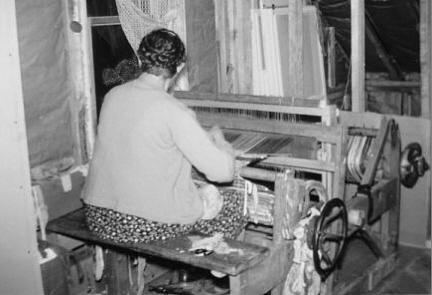
This is my Grandma, Anna Volovsek, working on her rug loom. I don't know when this was taken, or even where, for that matter--but, from the looks of the walls under construction, I'm guessing it was at the Volovsek farm, while the house was under construction, possibly in the late 1930's, early 1940's.
Shari Hahn
|
|
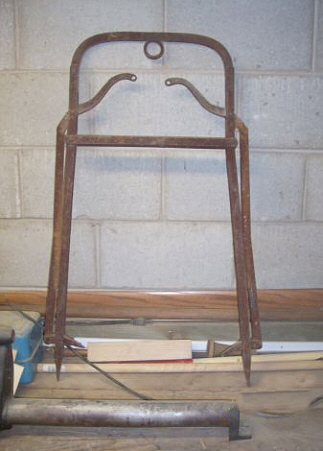
Hay Fork or Harpoon Fork. It is a single one that was used to pull hay up into the mow. It was jabbed down into the hay and the two bars at the top were pulled up to make the prongs at the bottom and grab the hay. This was connected to a very long rope that ran on a track. It was pulled to the rafters of the barn, by a long rope that was attached to a horse(s) or a tractor. The team of horses did the pulling and when it reached the right place over the mow, the person on the hay wagon tripped the fork to release the hay in the mow. (If the horses or tractor went too far it would pull the fork out the end of the barn, then it was TROUBLE.) He would then pull it back using the same rope and as soon as it hit the trip at the end of the hay fork track in the barn it would come back down to the wagon to be repeated until all the hay was in the barn.
Later it was replaced by a grappling type hook that had four hooks that took a much heavier load of hay into the mow. Still pulled by horses and tripped by the guy on the wagon that held the 'trip rope'.
|
|
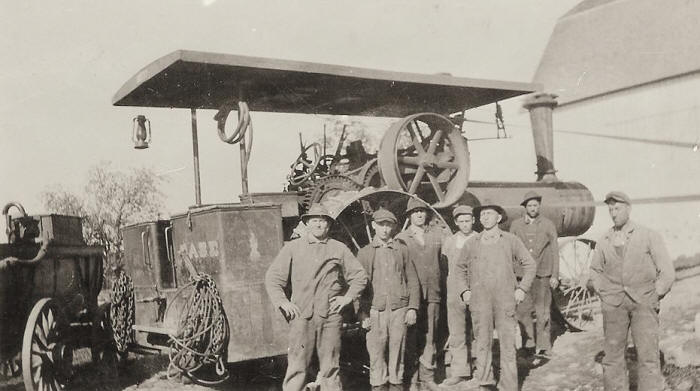
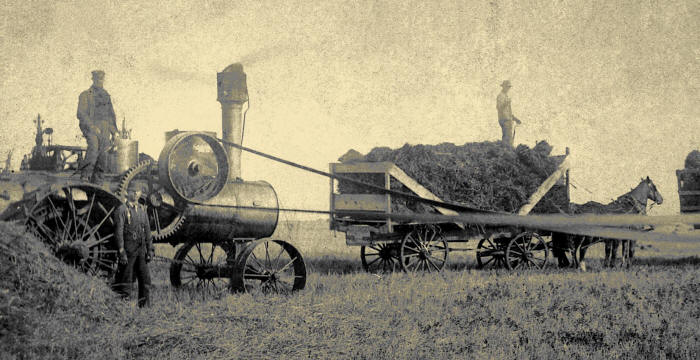
Combine (manufactured by the Case Corporation) This photo was taken in the rural Dorchester, Clark Co., Wis. area about 1901. It is from the Jantsch Collection. If you can identify any of the people pictured, please contact us. The origins of Case can be traced back to 1842, when Jerome Increase Case (born in 1819) created the J I Case Company. He is recognized as the first American to create a steam engine for agricultural use.
|
|
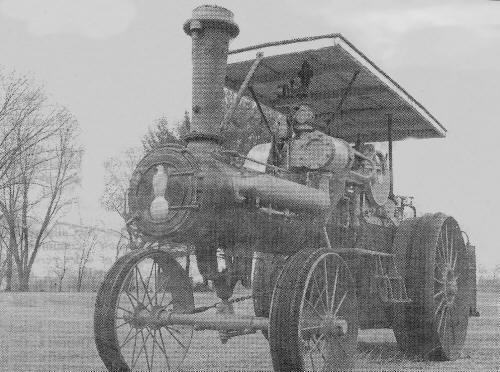
1916 Case steam engine, nine tons of cast iron and steel that helped drive the local economy many years ago has been kept on the grounds of WCCN Radio and its Wisconsin pavillion since 1969. This photo came from the Judy (Marden) Hansen Collection.
|
|
Corn (or seed) Planter. The seeds were placed into the canister, and would drop into the center of the tool when you pulled the handles apart. Then you would stab the tool into the soil, push the handles back together and the seed would be left in the ground when you lifted the planter out. You would take another step and do it again.
|
|
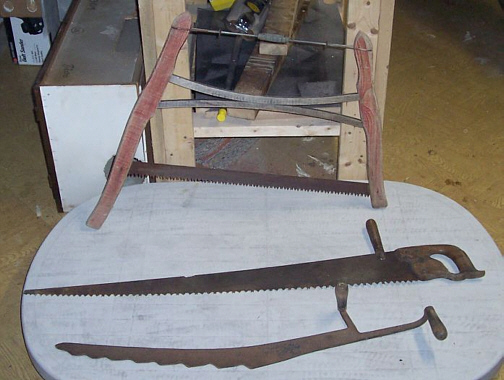
Top: Buck saw
Middle: One man cross-cut saw—otherwise known as a "misery whip"
Lower: Hay knife—used for cutting longer, or tightly packed, hay. The hay that wouldn't fit in the barn was stacked in the field in a long loaf shaped stack. Farmers would "slice" off a chunk of hay for easier handling.
|
|
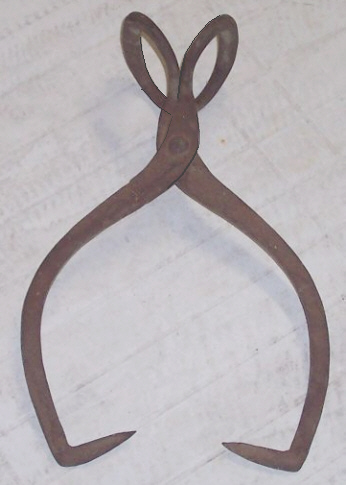
Ice tongs--Used to take ice off from the truck and carry to your icebox.
|
|
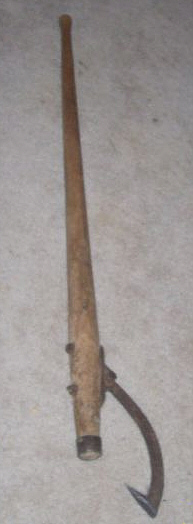
CANT HOOK--Used for "hooking" logs to roll them into a desired position.
|
|
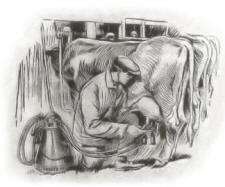
MILKING MACHINE (1932)--The McCormick-Deering pictured above advertised the highest efficiency, simplicity of design and operation. Every part was easily accessible for washing and cleaning. It had a patented vacuum pump with a replaceable cylinder. However, its manufacturer was not immune to the economic calamity caused by the Great Depression. In 1932, its sales fell 78 percent and its stock fell to $10.37 from a peak of $142 dollars a share in 1929. Tens of thousands of the company's employees were laid off and remained unemployed through most of the 1930s.
|
|
1901 - This Photo was taken in the Dorchester, Wis. area. It is from the Jantsch Collection.
|
|
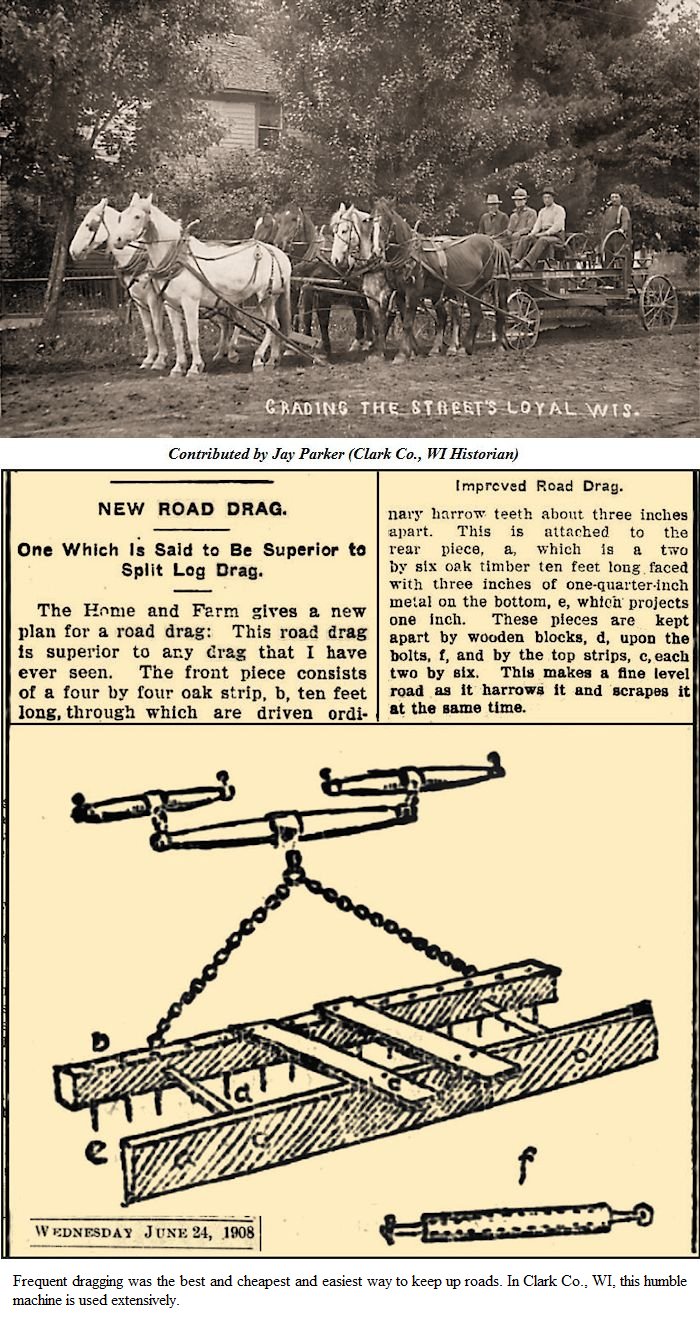
1908 - Drag for grading Roads. Postcard from the Jay Parker Collection.
Contributors
Shari Hahn, Judy (Marden) Hansen, Jim Jantsch, Jay Parker
& Janet Schwarze.
|
© Every submission is protected by the Digital Millennium Copyright Act of 1998.
Show your appreciation of this freely provided information by not copying it to any other site without our permission.
Become a Clark County History Buff
|
|
A site created and
maintained by the Clark County History Buffs
Webmasters: Leon Konieczny, Tanya Paschke, Janet & Stan Schwarze, James W. Sternitzky,
|