The Acquisition of Public Land
[Return to the Property & Land Indexes]
Additional Information, [ https://digicoll.library.wisc.edu/SurveyNotes/SurveyNotesHome.html ]
Surveying and Sale of Public Lands
Measurement, pricing, and distribution of public lands had been issues of concern and controversy since the Revolutionary War. This was especially the case with regard to the trans-Appalachian lands, part of which became the Northwest Territory, in which was included the present state of Wisconsin.
On the one hand were those who advocated selling the land in township units, as had been the practice in New England. The other side favored letting settlers stake their own claims, as in the southern colonies. The first method benefited land companies and speculators while the second benefited individual settlers.
To address these issues and to avoid the problem of boundary disputes associated with dividing the land by the "metes and bounds" system used previously, congress passed the Land Ordinance of 1785. The ordinance provided for the U.S. Government to survey the western lands into six-mile square township units, each whole township being surveyed into square-mile sections, numbered 1 through 36. Every other township was to be sold as a whole; the remaining townships were to be sold in square mile (640-acre) parcels. The minimum price was set at one dollar per acre.
Although meant as a compromise, the ordinance still favored large investors, for the $640 required to purchase a parcel of land was beyond the means of most prospective settlers. The minimum purchase was reduced to 320 acres by 1800. The Land Act of 1823 (3 Stat. 566), passed on April 24, 1820, further reduced the minimum lot size to 80 acres, set the minimum price at $1.25 an acre, and required payment in cash.
Homestead Act
The acquisition of land still remained out of reach for most settlers, hence a popular demand upon the government for free land. This and other economic factors led to the Homestead Act (121 Stat. 392), passed by Congress on May 20, 1862, and signed into law by president Lincoln. The act provided that “any person who is the head of a family, or who has arrived at the age of twenty-one years, and is a citizen of the United States, or who shall have filed his declaration intention to become such, as required by the naturalization laws of the United States, and who has never borne arms against the United States Government or given aid and comfort to its enemies, shall, from and after the first January, eighteen hundred and sixty-three, be entitled to enter one quarter section or a less quantity of unappropriated public lands.”
After five years residency and the fulfillment of other requirements which were subsequently added, the claimant could file for a patent at the local land office. The paperwork was then forwarded to the General Land Office in Washington, D.C. and, if approved, the claimant received the land free and clear except for a small registration fee. An amendment of 1872 provided that the amount of time Union veterans served in the Civil War could be deducted from their residency requirements. Alternatively, a claimant could gain title for a cash payment of $1.25 per acre after 6 months residency.
The act expired in 1976 in all states except Alaska, which was granted an additional ten years.
Bounty Land Grants
The Continental Congress passed resolutions as early as 1776 granting land to officers and soldiers who had served in the Revolutionary War. The Land Ordinance of 1785 specified the amount of land to be granted to each veteran, ranging from 100 acres to 1100 acres, depending on his rank. Several more wars were fought and in 1855 the Scrip Warrant Act (10 Stat. 701) was passed. It provided that each of the surviving officers and soldiers of specified rank who had served at least fourteen days in any war since 1790 was entitled to receive a warrant from the Department of the Interior for 160 acres of land. Revolutionary war veterans were included, as well as soldiers who were engaged in battle but had served less than fourteen days. Also included were certain non-combatants such as musicians, teamsters, and chaplains. Deserters and the dishonorably discharged were excluded. Veterans who had already been granted a warrant under the Continental Congress for less than 160 acres were entitled to a new warrant for the difference. Widows of veterans were entitled to the veterans' warrants, as were minor children if both parents were deceased.
The warrants were not granted automatically; the claimants had to apply for them. Once granted, the warrant could be used to apply for a land patent. A warrant could be transferred or sold and, in Clark County at least, that is what happened in most of the cases. There are only a few instances in which a warrantee opted to receive the patent for his land.
Agri-College Grant
The Land Grant College Act of 1862 (12 Stat. 503 - 505), entitled "An Act donating Public Lands to the Several States and Territories Which May Provide College for the Benefit of Agriculture and the Mechanic Arts" was enacted on July 2, 1862. Each state and territory was donated a quantity of public land within its own boundaries equal to 30,000 acres for each of its senators and representatives in congress. Proceeds from the sale of the land were to be placed in stocks yielding at least a 5% return. The returns on the investments were to be used by the states to finance universities, agricultural colleges, and technical schools.
School Section
The Land Ordinance of 1785 reserved section 16 of every township for the maintenance of public schools within the township. The Enabling Act of August 6, 1846 (9 Stat. 56) authorized the formation of a Constitution and State government by the people of Wisconsin Territory. Paragraph 1, c. 89 provided “that section numbered 16 in every township of the public lands in said State, and, when such section has been sold or otherwise disposed of, other lands equivalent thereto, and as contiguous as may be, shall be granted to said State for the use of schools.”
The Act of June 21, 1934 (48 Stat. 1185; 43 U.S.C. sec. 871a), entitled “An act authorizing the Secretary of the Interior to issue patents to the numbered school sections in place, granted to the States by the Act approved February 22, 1889, by the Act approved January 25, 1927 (44 Stat. 1026), and by any other Act of Congress,” authorized issuance of patents to the numbered school sections granted for support of common schools. In Clark County, these patents were issued on June 10, 1940 (1108458); August 16, 1941 (1111873); September 20, 1941 (1112025); and September 25, 1941 (1112078).
The act was repealed effective October 21, 1976.
Indian Homestead Fee
Land allotted to individual Native Americans could subsequently be sold by them or their heirs. Two types of patents allowed for the resale: The Indian Trust Patent which was held in trust by the United States for 25 years, after which the land could be sold; and the Indian Fee Patent, which was the actual title to property entirely owned.
Recreational Land Purchases
The Recreation Act of 1926, 44 Stat. 741 as amended by the Recreation and Public Purposes Act of 1954, (68 Statute 173; 43 United States Code 869 et. seq.,) provides that the Secretary of the Interior may “dispose of any public lands to a State, Territory, county, municipality, or other State, Territorial, or Federal instrumentality or political subdivision for any public purposes, or to a nonprofit corporation or nonprofit association for any recreational or any public purpose consistent with its articles of incorporation or other creating authority.”
Patent Plat Map Atlas
Patent Maps
The maps in this atlas were compiled from data collected from the General Land Office (GLO) records database, as published on the Bureau of Land Management (BLM) website. The website lists patentees, land descriptions, transaction type, authority, and other information, as well as images of the land patent documents.
The maps in this atlas are similar in appearance to ownership plat maps as published in plat books. The main difference is that the patent maps do not represent a "snapshot in time," but rather show the first owners, or patentees, of each parcel, regardless of when the parcels were acquired. Additionally, cities and villages are not shown, since they were not yet in existence when some of the land was acquired. Natural features are likewise not shown, except when they were used as a land boundary, as in the case of the numbered lots along the Black River.
Pattern fills are used to distinguish between the various authorities by which the parcels of land were acquired. A key to the patterns accompanies each map.
Footnotes
Some of the names on the patentee lists do not appear on the maps for various reasons. Explanations for them are found in the footnotes following each map. In the case of multiple owners of small parcels, only the first owner listed is shown on the map; the others are listed in a footnote. All of those associated with land grants—widows, minor children, attorneys, administrators, and assignees—are listed as patentees. The soldier who received a land grant was not considered a patentee and is thus not included on the maps or in the footnotes unless he opted to exercise his warrant and accept the property. The instances where this occurred are documented in the footnotes. In most cases, he sold or otherwise assigned his warrant to another party who either exercised it or subsequently sold or transferred it to someone else. Only the final patentee or patentees—who took possession of the land—are shown on the map. All others are listed in the footnotes.
First Owners Lists
Each map has a corresponding list which shows all of the patentees and land grant warrantees for that township as listed in the GLO records database. Information in the list includes parcel location, transaction type, transaction date, accession number, and document number. The lists are arranged in order by section number and parcel description.
Land Grant Warrantees
There is a separate, alphabetical listing of soldiers who applied for and received warrants. Information in the listing includes rank, the war served in, and the number of acres granted.
Land Descriptions
The Land Ordinance of 1785 provided that land be surveyed into township units, each unit being six miles long and six miles wide. Each township was to be subdivided into 36 sections of one square mile (640 acres) each.
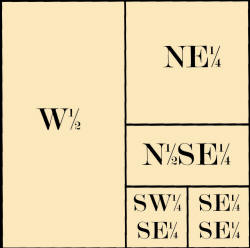
For the purpose of describing individual parcels, each section of land is divided into four 160-acre quarter-sections and each quarter-section into four forty-acre parcels.
The effect of imposing a square pattern on a curved surface (that of the earth) requires some sections to be more or less than the nominal value of 640 acres in size. In Clark County, these fractional sections are located along the northern and western boundaries of the townships. Parcels located along those boundaries will comprise more or less acreage than their nominal values.
Two types of parcels are described in the patentee lists. The first is rectangular and is described by its location within the section. For example, SW¼SE¼ is an abbreviation for the southwest quarter of the southeast quarter, a 40-acre parcel. N½SE¼ describes the north half of the southeast quarter, an 80-acre parcel; and NE¼ describes the northeast quarter, a 160-acre parcel. The second type of parcel is the numbered lot, used for odd-shaped parcels along the Black River, and for parcels located in fractional sections along the western edge of some townships. For the purpose of compiling the patent maps, the locations of the numbered parcels were determined by reference to older plat maps. The system by which they were numbered is not consistent among all of the townships, or even—in some cases—among different sections in the same township.
Access to Additional Information
Not all of the data which is available could be included here. For additional information, users may access the Bureau of Land Management (BLM) website.
Preface to the Second Edition
Since these maps were first published to the internet in 2008, the GLO has added many more records to its database. With but a few exceptions, the additions for Clark County came from bounty land grants and agri-college grants. The maps have been updated accordingly with the addition of 1,907 parcels. A few errors in the previous edition were discovered and corrected.
Index maps identifying the numbered lots in applicable townships have been added.
The patentee lists accompanying the maps have been changed to a hopefully more user-friendly layout. The lists are now ordered by parcel location and include the names of warrantees. This addition has eliminated the need for three separate warrantee listings, so now a single warrantee listing, arranged alphabetically by name, suffices. The alphabetic list of patentees is still available to users who wish to look up patentees by name. All of the lists have been updated with the information which has been added by the GLO to its database.
Disclaimer
As careful as we may be in compiling, checking, and rechecking these maps, some errors are bound to escape our notice. Some are traceable to the GLO records database; others are the fault of the cartographer. In any case, we are grateful to those users who call them to our attention so that they may be rectified. In addition, we will do our best to address any other issues or questions submitted to us by the users.
|
© Every submission is protected by the Digital Millennium Copyright Act of 1998.
Show your appreciation of this freely provided information by not copying it to any other site without our permission.
Become a Clark County History Buff
|
|
A site created and
maintained by the Clark County History Buffs
Webmasters: Leon Konieczny, Tanya Paschke, Janet & Stan Schwarze, James W. Sternitzky,
|