|
Businesses
Pine Valley
Cheese & Dairy
Cemeteries
Neillsville City
North
Pine Valley
South
Pine Valley
St. Mary's
Catholic
County Cemeteries
Changing Times
Churches
Communities
Historic Community Life
Neillsville/Co. Seat
Staffordsville
Sydney
Families & Homes
Pine Valley Township
Anniversaries
Biographies
Marriages
Obituaries
History
Highground News
Pine Valley History
Clark County
Local
News
Clark County
Neillsville
PineValley
Maps
Pine Valley Plat Maps
First Owners Plat Maps
Clark County
Townships
Memories & Letters
Military
Organizations
Photo Albums
Schools
Tragedies
Surname
Contacts
Surname Search
|
Pine Valley Township originally encompassed all of
what is today known as "Clark County" as well as what
eventually became the southern portion of Taylor County.
Township division began in 1856 and was completed in 1923
with the creation of Foster, which was the 33rd township.
The present town consists of congressional township No. 24
north of range 2 west except what is embraced in the city of
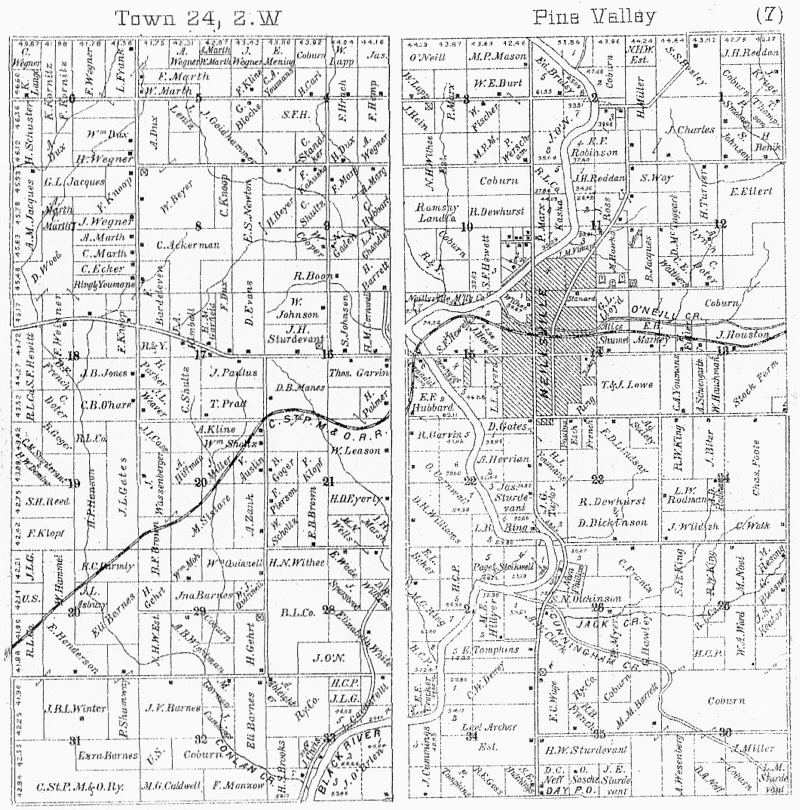
Neillsville. The location of the
Ghost town of "Day"
is noted on the 1893
Map of Pine Valley.
Such a gentle
rolling country side with its hidden valleys and majestic
pine forests could not have been more appropriately named.
Early loggers prospered by turning the lucrative white pine
forests into a substantial income and magnificent homes.
Later, many immigrant families arrived to farm the cleared
land. The pines primarily exist in recorded history,
but the valleys, the farms and the sweeping blue skies
remain. Reforestation has been highly valued and
today, large portions of the county are flourishing with
hardwoods which not only continue to provide income, but
also serve as recreational preserves and parklands.
Neillsville, the county seat
and metropolis of
Clark County, is situated on the Chicago, St. Paul,
Minneapolis and Omaha Railroad, and is the distributing
center of an important agricultural dairying and
stock-raising district. The city presents a most attractive
sight nestled among the green hills and in the midst of wide
expanses of fertile acres, where the dark currents of Black
River tossing over the rocks mingle its murmuring with that
of Placid O'Neill Creek. On a railroad which brings three
passenger trains each way each day-- one each way a through
train from the metropolis of one state to that of another-
and with good improvement roads leading out in each
direction, north, east, south and west, to stretches of fine
farms, with its court house surmounted by the blindfolded
holder of Justice's scales and its other public buildings
outlined against the sky or against the background of
encircling hills, with its blocks of busy marts and its
streets of beautiful homes, Neillsville can take pride in
the fact that it is a truly representative American city,
which has a history of which it may well be proud, and
prospect for future growth and development which is its
pride, boast and hope.
The main business section is
Hewett Street, named after James Hewett, one of the pioneer
settlers. The city lies back nearly a half mile from the
banks of Black River, but O'Neill Creek runs nearly through
the center of town circling from west to east, dividing it
into the north side which contains the Catholic Church and
school, the cemetery, the ward school and some desirable
residence blocks, and the south side which comprises the
business streets, the county buildings, high school, new
Carnegie library, and many new and very beautiful homes.
There is a large armory for the use of the company of
militia, which is also used for a theatre and hall for
dances. This is owned by a local stock company.
The city owns and operates the
waterworks, procuring its supply from Black River, and there
is an adequate system of sewerage, and the electric light
and power is furnished to the city and private consumers by
a substation to a large company, the energy being derived
from water power a score or miles distant.
The most important business
industries are the condensary and the canning factory, and
there are a number of thriving minor enterprises. The three
banks have slightly modern buildings, and the churches are
adequate and well built, all the leading denominations being
well represented.
The story of the early settlement
of Neillsville has already been told. The village was plated
by A. Boardman for James O'Neill on April 14, 1855. At that
time, O'Neill's residence and mill, with Samuel Ferguson's
bachelor's hall and his blacksmith shop, were the only
buildings to be seen on the four acres appropriated to
village purposes. Immediately the news of Mr. O'Neill's
action had been promulgated, settlers began to come in,
purchase lots and make improvements. The first of these was
Robert Roix, who erected a tavern. Then James O'Neill
erected two frame buildings for store and residence
purposes. The same spring N. M. Clapp settled in the village
and built a house on the present site of the post office,
and Dr. L. M. Baxter put up a residence. The same year Frank
Cawley came in, also W. K. Dickey, who built a wagon shop
and residence, and that fall, Clinton & Quaile brought a
stock of goods from Black River Falls, and became the first
merchants in the village, doing business in the building
erected by James O'Neill. These were the arrivals and
improvements of 1855.
The arrivals of
1856 included Richard Dewhurst and G. W. King, who were the
first lawyers to settle in Neillsville; James Hewett, who
began operations by working on the first bridge erected
across Black River, W.W. Lemon, who settled in the town of
Levis; Daniel Gates, first locating at the mouth of Wedge's
Creek, but moving to Neillsville in 1861; Robert Douglas,
who built a blacksmith shop; Miles Murry, who erected a
residence and a blacksmith shop. James R. Mc Calep came in
this year, and put up a little frame building, and Phillip
Reissman opened the first furniture store. In May, James and
Edmund Furlong, the former with a family; James Lynch and
family and Orson Gates were accessions to the place. Anson
Green purchased Roix's Hotel. Gustavus Sterns settled at
Molin's Rapids this year.
|
|
The panic of 1857 worked material injury to the process of
the village, as also to that of the county. Few came in from
this year until after the close of the war. Financial
stringency produced a practical suspension of the lumber
interests, and consequent stagnation of business. There was
comparatively no farming of consequence, and less trade. The
value of farm products depreciated, and prices of
commodities increased correspondingly. The effect of these
anomalous conditions were perceptibly visible, not alone in
Neillsville and Clark County, but also throughout this
portion of the lumber district. Impoverishment, if not ruin,
stared many in the face, and escape from there was only
accomplished after trials no pen can adequately describe. To
the close of the war, both increases in population and the
number of improvements was nominal.
Neillsville, in the early fall of 1866, was a village of a
few dozen buildings scattered on the north side of O'Neill
Creek, near where the old electric light plant stands. The
mill was an old-fashioned one, with an up and down saw, run
by water power, but at the time mentioned it was out of
commission. It was a year after that it was either rebuilt
or repaired by Marville Mason, then of the town of Pine
Valley, a good man and a good millwright, who long since has
gone to his reward.
On the north side of O'Neill Creek, in what is known as the
first ward of the city of Neillsville, there was a
blacksmith shop, and not to exceed three or four houses in
all of that territory- one of them being the home of James
Furlong- that then stood on the same land, and near the site
of the fine brick building, built by Gus D. Hosely a few
years ago. The north side was nearly all woods.
On the south side of the creek and on the same location as
the present Merchants Hotel, was a dilapidated frame hotel
called the Hubbard House, then kept by L. K. Hubbard.
Across the main street, or Hewett Street, as it is now
called, and a little south of Carl Rabenstein's brick block,
was a small two-story frame building, the upper story of
which was occupied by a man by the name of Tim Roberts, who
made logging sleds, at least he made the wooden parts.
Below, on the first floor, was the store of Hewett, Woods, &
Co. The room was small, and the store then had no clerks,
nor window trimmers. The one front window was of the
two-stash, 8 by 10 glass variety, and incapable of being
decorated very elaborately. The books, such as they were,
lay on the top of an empty kerosene barrel that did duty as
a desk, when such an article of furniture was required.
About November, 1866, the store was vacated and the goods
removed to a building that stood on the corner where
Neillsville bank now stands. This building was a store and
dwelling combined, occupied by Chauncey Blakeslee and his
family, and it was only a short time until a very large
stock of goods were on the shelves.
Back of and to the north of the original store of Hewett,
Wood & Co., and facing the north, and the creek, was the old
frame dwelling house of James O'Neill, then occupied by
James Hewett and his family, consisting of a wife and one
son, then about one year old, and names Sherman F. Hewett.
The son is the present county surveyor of the county, and
more familiarly known as Frank Hewett.
All of the land on the east side of Main Street, including
the first store building first mentioned, and the house
occupied by James Hewett were the property of Mr. O'Neill,
and there were no other buildings on the east side of the
street from O'Neill Creek to the present O'Neill house. On
that corner Mr. O'Neill had built a two-story frame building
for a residence, which he then occupied and, afterward for a
time, ran a hotel there.
On the west side of the street, across from the Hubbard
House, was a drug store, the proprietor being George O.
Adams. He was a full-fledged Yankee from Nashua, N. H. He
generally wore a long pair of rubber boots, and always wore
a high silk hat. He was a keen business man, but somewhat
odd in his manner. One of his common expressions in
conversation was, "I want to know." He died in Waukegan,
Ill, years ago at a very advanced age. South of the
drugstore was a general store kept by Charles E. Adams, a
son of the druggist. It occupied the site where the elder
John G. Klopf for many years afterwards resided and had a
saloon. It is the building now occupied by August Storm.
On the corner where Neillsville bank now stands was a
dwelling house of Chauncey Blakeslee, the lower part being
used as a store for Hewett, Woods, & Co. From the corner
south, clear to the end of the block, was an apple orchard
and garden.
Across the street on the east side was a printing office and
post office, both one-story frame buildings, and to the
south of these buildings was the wagon shop of W. K. Dickey.
Dr. B.F. French had a house on the corner of Fourth and
Hewett Streets, and south of that was the house of Lambert
Miller. To the west there was a house on the old Ross place,
and Samuel Ferguson and L. L. Ayers had their residence
across the way. On extreme east was the house of W. K.
Dickey.
The first sidewalk in Neillsville was built on a Sunday
morning in the spring of 1867. It was constructed by B.F.
French, James Hewett and two or three others. It extended
from where the Neillsville bank is located to the corner at
Marsh's dry goods store. It was made of plank (laid
lengthwise) and did good service for many years.
It was in the seventies that the first brick store was
erected in Neillsville. This was the store building of
Hewett, Woods & Co., built in 1872, on the northwest corner
of what is now known as Fifth and Hewett streets, the same
building occupied at present by W. J. Marsh and the Masonic
fraternity. A few years later George L. Lloyd erected a
brick store building directly opposite on the northeast
corner of the same streets. It was built of cream colored
brick brought from Depere, Wis. This building is now
occupied by the Cash Hardware Company.
The store of Hewett and Woods was always called the "Brick
Store". It carried a large stock of goods, and employed a
number of clerks and office men, among whom were David R.
Brown, Stanley F. Chubb, Frank S. Kirkland, John Duncan,
Charles Deutsch, Tobias Johnson, who kept his jewelry goods
there, Charles D. King and others.
All of these men were more or less influential in politics
or, at least, in getting votes, and when they started out
for anything they generally succeeded.
With this beginning the city has enjoyed a steady and
satisfactory growth, and its prospects for future years are
of the brightest.
For nearly thirty years after it was platted, Neillsville
was a part of the township of Pine Valley, and was governed
by the officials of that township. At the first town meeting
of Pine Valley, April 4, 1854, the following officers were
elected: Supervisors- James O'Neill, James French and Hugh
Wedge; town clerk- B.F. French; justice of the peace--Moses
Clark and James Conlin; assessor--James O'Neill;
constable--B. F. French; Superintendent of schools- James
O'Neill; overseer of highways--James Conlin, Conrad Dell and
Elijah Eaton. A tax of $1,000 was levied, $200 for a bridge
across Wedge's Creek and $800 for bridging, widening and
cross-waying the road surveyed along the Black River,
commencing at the south line of Town 23, Range 2 West, and
thence up Black River to the north part of Town 26, Range 2
West. At a special meeting held Oct 5, 1854, Edward Tompkins
was elected supervisor in place of Hugh Wedge, and James
O'Neill was elected superintendent of schools. It was voted
to raise $1,000 to open a road on the east side of Black
River and $200 for incidental purposes. School District No.
1 was designated by James O'Neill. Its boundaries, as given
in the records, were indefinite, but it probably consisted
of the south two-thirds of what is now Pine Valley.
In the late seventies the agitation for a separate
government for Neillsville assumed encouraging proportions,
and the necessity for such separate organization became
imperative with the arrival of the railroad in 1881.
Accordingly, the city of Neillsville was duly incorporated
by an act of legislature, approved March 28, 1882, to take
effect the second Tuesday in April of that year.
Electric lighting was inaugurated in 1882, when the private
electric light plant was put in, furnishing four or five arc
lights. But the Neillsville Electric and Water Supply Co.
was soon organized, a building was constructed north of the
creek, and the city was supplied with good service for
street, business and residential purposes. In the fall of
1906 the plant was acquired by the city. In 1915 a contract
was made with the Wisconsin- Minnesota Light and Power Co.,
and the local plant abandoned.
The waterworks system was originally installed in 1885, when
a dam was built across O'Neill Creek, and a plumbing station
erected north of the creek. This building and the adjoining
electric light plant are still standing, but are not now in
use by the city. In 1890, the standpipe was erected on the
hill, a few rods southeast of the court house. The system
has been extended from time to time until it now covers the
principal streets. August 23, 1895, the council decided to
move the plumbing plants to Lot 5, Schuster's Addition, and
a few days later let the contract for the erection of a
stone and brick pumping station. The plant was completed the
following year. The old plant was sold to the Neillsville
Electric & Water Supply Co. At a special election held Oct
30, 1906, it was voted to erect a dam on Black River. The
work was completed the following year. April 27, 1917, a
contract was let for a new filtration system, and the work
was completed in the spring of 1918.
For some years after the organization of the city, there
were no public sewers, sanitation being achieved by private
sewers and cesspools. From time to time short strips of
sewers were laid, the first extensive inauguration of that
system being in 1902, when sewers were laid on Seventh.
Hewett, Court, West and Fourth Streets. The system has since
been continued so that the principal residence and business
streets are now well provided with sanitation facilities.
The city has an excellent system of bridges, well cared for.
The bridges have been built at various dates as necessity
has required. July 13, 1901, the city bought a rock crusher
and Aug. 10, 1901, a stone roller. May 14, 1904, an
appropriation of $3,000 was made for macadamizing certain
streets in the summer and fall. This work has since been
continued until the principal streets are all macadamized
and in the best of condition.
The Neillsville Library Association was organized Sep. 23,
1879, by the election of H. W. Deming. President; Ira B.
Jones, treasurer, and L. B. Ring, librarian and secretary,
with H. N. Withee, C. Blakeslee and Mrs. A. White, trustees.
The library was established in the office of the True
Republican. March 13, 1897, the citizens of the city voted
to establish a public library and reading room. The library
was maintained at the High School until 1914, when the
present Carnegie Library was erected. The preliminary steps
toward the building of the library were taken in 1913. Nov.
13, 1913, the city council received a communication through
Mrs. J. W. Hommell, stating that the Carnegie Corporation
would contribute $10,000 toward a library building at
Neillsville, providing that the city council would provide
$1000 a year for its maintenance. The conditions were duly
complied with, and after a consideration of various
localities, the present site was selected, being paid for by
a tag day contribution of $417.13, and a subscription from
various prominent citizens. The building is a sightly one,
and the institution is well conducted.
Neillsville Post office was first established as Clark Post
office, May 31, 1855, with Samuel C. Boardman as postmaster.
The name Clark was changed to Neillsville Oct 6, 1856, and
Mr. Boardman appointed a second year. Then followed George
W. King in 1857; Chauncy Blakeslee in 1858; Wm. C. Tompkins,
1860; C.W. Carpenter, 1863; A. J. Manley, 1865; Wm. C.
Hutchinson, 1867; J. W. Ferguson, 1871; Wm. Campbell, 1882;
Isaac Carr 1886; Fred Reitz, 1890; William Huntley, 1894; L.
B. Ring, 1899; A. E. Dudley, 1906. He was followed by
William Huntley, the present postmaster. When this office
was first established, 1855, mail was brought here from
Black River Falls by Edward Markey.
Religious life has been a dominating factor in Neillsville
life since the earliest days. All leading denominations are
represented here, and there are many sightly church edifies.
There are Presbyterian, Congregational, Methodist,
Episcopal, Christian Science, Catholic, Norwegian Lutheran,
German Lutheran, and Zion Reformed churches here, and a
Unitarian Church formerly flourished for some years.
Sources:
Robert McBride's 1909 History of Clark County, Wisc.
|